A double calendar needs more than an automatic winding label
Automatic describes how wrist movement can wind the mainspring. The calendar has a separate task: presenting the date and weekday and advancing them in the correct daily sequence. A full word across twelve o'clock requires a display arrangement suited to that aperture.
| Reference | Documented arrangement | Why the distinction matters |
|---|---|---|
| Rolex 3255 | The current genuine Day-Date 36 and 40 mechanism, with day and date displays. | This identifies the original design's mechanism. It is not an ETA reference or the identity of an unnamed replica. |
| ETA 2834-2 | ETA's 2016 Mecaline catalogue specifies date at three and an external weekday display at twelve; movement diameter 29.00 mm, height 5.05 mm. | A named example of a weekday arrangement relevant to a long upper window. The larger outer display has to be accommodated by the dial and case assembly. |
| ETA 2836-2 | Day and date in windows, with correction and stop-seconds; diameter 25.60 mm, height 5.05 mm in ETA's product record. | The general phrase day/date does not specify the same external weekday arrangement as the 2834-2 catalogue entry. |
A replica described as using a 2836-style base may add or change calendar components to suit its dial. That complete arrangement, rather than the base family name alone, determines the position and language of the visible weekday. It also matters when sourcing calendar parts: the base movement's ordinary parts list may not describe an added display assembly.
Scope: these are documented manufacturer architectures, not a list of mechanisms verified inside replica stock. The examples below use invented observations to teach comparison. Specific setting positions and calendar-correction restrictions must come from instructions for the mechanism actually fitted; the function guide keeps that operating step separate from passive observation.
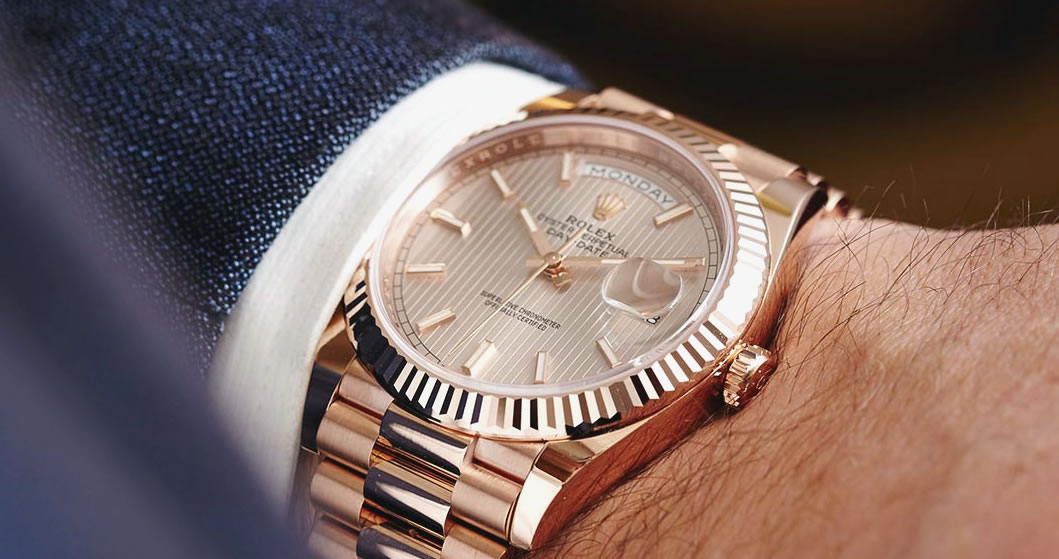
Read the whole word, then follow a whole calendar sequence
Confirm the required language before choosing the dial colour. Then compare a short and a longer weekday in a square-on view, under the same light. For an English disc, Monday and Wednesday make useful contrasting samples. Check both ends of the word, the lettering's vertical position and clearance from the window; a well-positioned short word can conceal trouble elsewhere on the disc.
Three observations answer three different questions:
- Static readability: can you see the complete word at your ordinary reading distance, without moving to a special angle?
- Daily progression: during normal running, do weekday and date both reach their next correct reading after a full daily cycle?
- Full sequence: do all seven weekday positions appear in order, including the change from Sunday to Monday?
A set of seven still photographs can help with printing and position. A continuous daily observation, or a demonstration using the correct operating method, is needed to show progression. Keep these records separate: attractive static photographs do not tell you whether the drive advances both discs.
A completed example: a moving calendar can still be hard to read
Hypothetical teaching case, not a test report. The reader requires English, a complete readable weekday and an ordinary working date. Candidate A is a 36-style watch; Candidate B is a 40-style watch. Their bracelets fit the reader comfortably in this invented comparison.
| Check | Candidate A | Candidate B | Decision supported by the observation |
|---|---|---|---|
| Language | English | English | Both meet the selected language. |
| Square-on word reading | Monday and Friday are complete; the final letter of Wednesday is visibly cut by the right edge in repeated square-on views. | Monday, Tuesday, Wednesday, Thursday, Friday, Saturday and Sunday are complete and readable. | A has a repeatable display-readability issue even though its short words look good. |
| One daily change | Friday / 16 at 23:55; Saturday / 17 when next checked at 00:10. | The same correct sequence at the same observation points. | Both complete that daily advance within the observation interval. The exact change time has not been measured. |
| Sequence through a week | Correct order through seven positions, including Sunday to Monday. | Correct order through the same sequence. | Progression works in the example; this does not remove A's clipped-word issue. |
| Selection | Set aside this example because complete weekday reading is essential. | Choose B for this reader. | The larger configuration wins on a demonstrated reading requirement, not a rule that 40 is always more legible. |
The failure in A is described precisely as a clipped Wednesday. It is not called a broken automatic movement: the observations actually show calendar progression. Resolving the printing, disc position or aperture relationship would require inspection; until then the supplied display fails the reader's stated requirement.
Another pattern would lead elsewhere. If the date reached 17 while the weekday remained Friday throughout the next full running day, the record would identify a missing weekday advance rather than a word-fitting problem. Save the before-and-after displays and stop treating a clear photograph as evidence of a working double calendar.
If both displays change regularly around noon, first establish the twelve-hour phase of the hands before describing it as a calendar fault. A twelve-hour dial alone does not distinguish noon from midnight. Movement-specific instructions determine the appropriate correction, not a guessed quick-set operation.
Use 36 and 40 as design references, then compare actual fit
Two genuine configurations keep much of the style direction similar: 128238-0045 is a 36 mm Day-Date with a champagne-colour dial, fluted bezel and President bracelet in yellow gold; 228238-0006 is the 40 mm direction with the same broad colour, bezel and bracelet description. Their published 36/40 sizes identify the designs, not the dimensions of a replica case or its end links.
For a practical comparison, use the same plan view and note the point where the bracelet begins to curve down. A rigid end-link extension can increase the span across the wrist; a smaller diameter does not cancel that extension. Check the clasp underneath as well: a bracelet that drapes around the top but leaves the clasp off-centre may still be uncomfortable at a desk.
The long weekday window deserves a normal-distance reading check on both sizes. If both are readable, the larger dial has not solved a reading problem for you; let fit and appearance decide. If only one is comfortably readable in ordinary light, that is a concrete reason to accept its different case presence. The Datejust fit method explains how to keep case diameter, effective span, height and fitted bracelet length separate.
Break a material description into parts
Genuine Day-Date material specifications describe precious-metal watches. Replica descriptions can instead refer to a steel base, a coloured surface or a weighted construction. Read the actual wording part by part rather than treating a gold colour or a heavy feel as the missing material specification.
Consider the invented description “steel case with gold-coloured finish and matching bracelet.” It can be interpreted without either endorsing or dismissing the watch:
| Part | What the wording supplies | What to keep separate |
|---|---|---|
| Case | Steel is the claimed base material; gold-coloured finish is the surface appearance. | The finish process and layer thickness are not specified by the colour word. |
| Bezel | No separate material is named. | A matching fluted appearance is not a separate composition statement. |
| Bracelet and clasp | “Matching” supplies a colour or style relationship. | Their base materials and surface treatment need their own description if important to the choice. |
A useful weight comparison notes the complete bracelet configuration and removed links. It can help a reader decide whether a watch feels too heavy; it is not a substitute for composition analysis. For a coated finish, compare visible colour consistency at case, bezel, links and clasp in the same light, and follow care guidance for that actual surface rather than polishing it as though it were solid precious metal.
Choose the Day-Date-style layout if the weekday display is a real part of its appeal. If a date alone serves your routine, the Datejust guide offers a less complex calendar choice. Keep the completed reading and fit observations with the inspection record; use the movement reference for maker and origin terminology.
Reference notes
- Rolex, Day-Date current feature information and reference pages for 128238-0045 and 228238-0006. Used for genuine 36/40 configurations, precious-metal scope and calibre 3255. Checked 15 October 2026.
- ETA, Catalogue Mecaline, 2016, printed page 10: 2834-2 and 2836-2, including the external weekday at twelve in the 2834-2 entry. This is a dated architecture reference, not a current-stock statement.
- ETA, 2836-2 manufacturer product record: day/date, correction, stop-seconds and published dimensions. Checked 15 October 2026.