Recognize the four design directions
Look at the outer ring, dial surface, hands and calendar together. A name in a listing is easier to assess once you can describe the watch without that name. The following examples are genuine design references, rather than specifications for a replica.
| Design reference | Face and surround | Useful identifying detail | What the combination offers visually |
|---|---|---|---|
| Diver 300M 210.30.42.20.03.001 | Blue wave-pattern dial and a graduated blue diving bezel | Skeleton hands and a date window at six; a conical valve is a case-side detail | A patterned sports dial with an external timing scale and a centered lower calendar |
| Planet Ocean 217.30.42.21.01.001 | Matte black dial and black diving bezel | Four Arabic numerals; the new design uses squarer, sharper numeral styling | A numeral-led alternative to the Diver's wave pattern and skeleton-hand design |
| Seamaster 300 234.30.41.21.01.001 | Black dial and an aluminium diving bezel in the genuine reference | Recessed hour markers and open numerals; a domed crystal | A heritage direction with depth in the dial markings, rather than the blue Diver's wave surface |
| Aqua Terra 220.10.41.21.01.001 | Black horizontal teak-pattern dial without an external graduated dive bezel | Date at six and a symmetrical case; the dial texture runs in straight lines | An everyday sports-watch outline with more emphasis on the dial and bracelet |
These cues give you a first sorting method. Waves, skeleton hands and a six-o'clock date point toward the illustrated Diver configuration. A black face with horizontal grooves and no external dive scale points toward the illustrated Aqua Terra. Large numerals and a dive bezel send the comparison toward Planet Ocean or Seamaster 300, where the exact numeral, marker and case treatment matter next.
The examples do not describe every version in each family. In particular, Seamaster 300 and Diver 300M are different branches despite their similar names. The source titles and reference numbers used for this table appear at the end of the article.
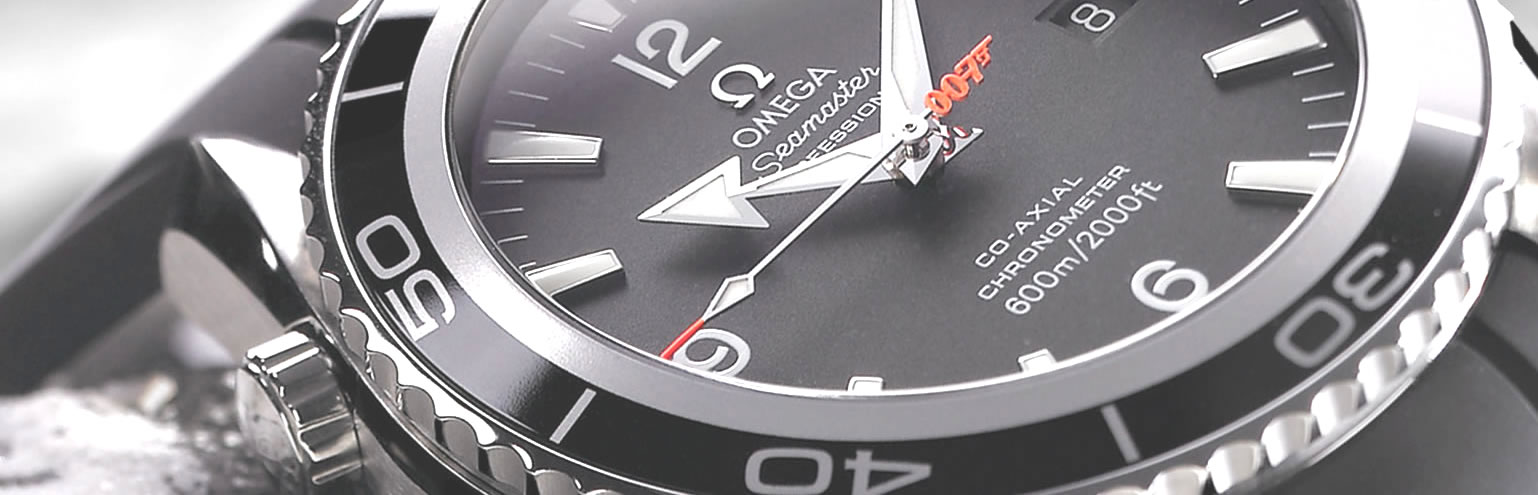
Tell an older Planet Ocean image from a newer design
The retained close-up from the previous Watchfora site shows a date aperture at three, large 6, 9 and 12 numerals, arrow-shaped hands and red 007 branding on the seconds hand. Those are useful visible clues. They do not identify the photographed watch's authenticity, exact reference or internal movement.
They also describe a different face from the four-numeral Planet Ocean example above. OMEGA's press release OMEGA Seamaster Planet Ocean, dated 18 November 2025, announces the fourth generation and its revised case and bracelet architecture. The product description for 217.30.42.21.01.001 adds the more useful visual detail: a matte dial, four Arabic numerals and a squarer, sharper treatment that follows the redesigned case and bracelet. Its technical data specify a flat crystal.
| Feature | Retained 007-branded close-up | Genuine 217.30.42.21.01.001 reference | Practical conclusion |
|---|---|---|---|
| Calendar/numeral arrangement | Visible date at three and large numerals at 6, 9 and 12 | OMEGA describes four Arabic numerals | Do not match the two faces merely because both are called Planet Ocean |
| Dial finish and printing | The photographed dial carries 007 branding and older printed wording | Matte black dial with the named current design's numeral treatment | Choose the face you prefer as a complete configuration |
| Case and bracelet | The close crop cannot show their complete shape or dimensions | The 2025 release identifies revised case and bracelet architecture | A matching dial crop cannot establish that a whole case follows the newer design |
| Size of a replica candidate | No reliable measurement supplied by this photograph | The original reference's dimensions belong to the original | Compare the candidate's measured diameter, height and wrist span separately |
For this limited comparison, the result is clear: the old close-up is suitable for discussing that older 007-branded appearance, while the new reference needs its own full views. It should not be used as a photograph of the fourth-generation reference. Equally, a replica can deliberately follow an older design; age alone does not make that design the wrong preference.
Choose the design by a concrete daily preference
You want a readable date and a sports bezel
Start with the illustrated Diver 300M configuration if you like a six-o'clock date and the contrast between skeleton hands and a wave dial. Compare the date through your normal viewing angle: its central lower position creates a different face from a date at three. If the numeral-led Planet Ocean appearance appeals more, choose its exact calendar layout first; the two illustrated Planet Ocean faces above already show why a family name cannot settle that choice.
You want a quieter case outline
Start with Aqua Terra rather than selecting a diver and trying to ignore its bezel. In the black-teak example, straight dial lines and the six-o'clock date form the center of the composition. A Datejust is a useful alternative if you prefer a date at three, a magnifier and a separate smooth or fluted bezel choice.
You prefer a heritage dive-watch face
The named Seamaster 300 reference provides specific details to compare: recessed markers, open numerals and a domed crystal. Look for that combined effect rather than treating warm-coloured markers alone as proof of the design. Choose it for those proportions and dial details; choose the illustrated Diver if a wave surface and skeleton hands are more important to you.
Design-choice example: suppose two candidates both fit and both have the working date you need. One follows the blue Diver layout; the other follows the black-teak Aqua Terra. If a prominent external timing scale is part of what you want, the Diver direction meets that preference. If you want less detail around the dial for everyday office wear, the Aqua Terra direction meets it. This conclusion follows from the layouts; it makes no claim that either replica is thinner, more accurate or better made.
Match the face to the functions you will use
The four reference examples above are not chronograph faces. A separate chronograph or GMT candidate needs a separate function description. Two pushers suggest controls, but do not tell you which subdial records elapsed minutes. An additional hand can show a second time zone only through the mechanism and setting arrangement actually provided.
| Your intended use | What to establish | Result that changes the choice |
|---|---|---|
| Read time and a date | Clear hands, a readable calendar and suitable setting instructions | A date that is hard to read at your normal angle defeats the reason for choosing that layout |
| Follow another time zone | Which hand shows it and which hand adjusts independently | A setting arrangement unsuited to your travel routine favors another candidate |
| Measure elapsed time | Running seconds, elapsed seconds and every claimed counter identified | A display that serves another function cannot replace the elapsed-time recorder you need |
The function guide supplies the detailed demonstration sequence and record. Use instructions for the identified mechanism before operating unfamiliar calendar shortcuts or pushers. There is no reason to repeat those general procedures for every Seamaster branch.
Read Co-Axial and calibre wording accurately
Co-Axial names an escapement design, rather than automatic winding or a smooth-looking seconds hand. In OMEGA's own product documentation, the calibre number identifies the mechanism in that genuine reference. The corresponding words on a replica dial or decorated rotor do not establish the mechanism beneath them.
A useful description names the actual maker and base movement, then explains any additional display mechanism or decoration. The movement-label comparison helps interpret ETA, a design-based clone label and an unnamed automatic. This is especially relevant if a listing repeats an OMEGA calibre number while describing a different base movement elsewhere.
The design choice and the engineering evidence answer different questions. Pick the branch whose display you want, then compare the actual candidate's dimensions, bracelet fit and mechanism. For water use, rely on appropriate assessment of that watch's condition, rather than a valve, a dial depth marking or an outdoor photograph. Keep the resulting observations in the inspection record.
If you are still choosing a design, compare the Submariner's date and no-date layouts or use the paired choices in the ten-style guide. Those comparisons narrow the visible and functional preferences before you spend time interpreting a movement label.
Reference documents and scope
- OMEGA, product description and technical data for Seamaster Diver 300M 210.30.42.20.03.001, consulted 15 October 2026: blue wave dial, skeleton hands, date at six and the named genuine configuration.
- OMEGA, product description and technical data for Planet Ocean 217.30.42.21.01.001, consulted 15 October 2026: matte dial, four Arabic numerals, sharper design treatment and flat crystal.
- OMEGA Press Room, OMEGA Seamaster Planet Ocean, 18 November 2025: fourth-generation launch and revised case/bracelet architecture.
- OMEGA, product description and technical data for Seamaster 300 234.30.41.21.01.001, consulted 15 October 2026: recessed markers, open numerals, named bezel material and domed crystal.
- OMEGA, product description and technical data for Aqua Terra 220.10.41.21.01.001, consulted 15 October 2026: horizontal black teak-pattern dial, date at six and the named genuine configuration.
- OMEGA Press Room, OMEGA Launches New Range of Seamaster Diver 300M Watches, 21 November 2024: additional metal-dial and bezel variations. The blue example in this guide is not a definition of every Diver 300M.
These documents support the identified genuine designs and the meaning of OMEGA's terminology. The retained site photographs support only the visible observations described beside them.